
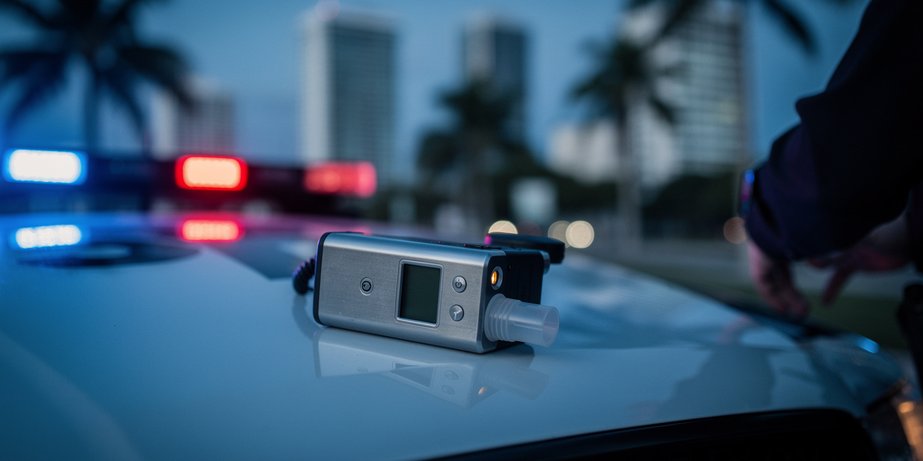
Blue lights fill your mirror. You pull over, roll down the window, and a few minutes later an officer is holding a small handheld device, asking you to blow into it. In that moment, you have a decision most drivers have never actually thought through. So here’s the short answer: yes, you can physically refuse a breathalyzer in Florida. But the law makes sure that refusal is never free. Refusing might keep certain evidence out of the state’s hands, yet it sets off automatic penalties that kick in long before you ever walk into a courtroom. Let’s break down what a refusal really costs, the exceptions worth knowing, and the narrow window you have to fight back.
Florida’s Implied Consent Law Explained
When you accepted your Florida driver’s license, you already agreed to something you probably don’t remember agreeing to. Under Florida’s implied consent law (Fla. Stat. § 316.1932), every licensed driver has consented in advance to submit to a lawful breath, urine, or blood test. That’s the trade-off for the privilege of driving on state roads.
But there’s a catch that matters. Implied consent only applies after a lawful arrest backed by probable cause for a DUI. It doesn’t give an officer the right to demand a test at any random moment. Before a test, the officer is supposed to read you the implied consent warning, telling you that refusing will suspend your license and that a second refusal is a crime. If that warning is missing or botched, it can matter a great deal later. So while you can refuse, you can’t refuse without consequences.
What a First Refusal Costs You
A One-Year License Suspension
Refuse for the first time and you’re looking at an automatic administrative license suspension of 12 months. This comes from the Department of Highway Safety and Motor Vehicles, not a judge. That distinction is bigger than it sounds. The suspension is separate from, and stacked on top of, whatever happens with your criminal DUI case. Even if the DUI charge gets dropped entirely, that driver’s license suspension can still stand on its own.
Your Refusal Becomes Evidence
People assume refusing leaves the state with nothing. Not true. Prosecutors are allowed to bring your refusal into trial and argue it shows “consciousness of guilt.” In plain terms, they’ll tell the jury you refused because you knew you were over the limit. And the clock is already ticking. Your DUI citation doubles as a temporary driving permit, but you have only 10 days to challenge the suspension. More on that below.
First Refusal vs. Second Refusal
This is the part most drivers get wrong, and it’s a costly misunderstanding. A first refusal is an administrative matter. A second refusal is a whole different animal.
If you’ve refused before and refuse again, you’re facing an 18-month license revocation plus a first-degree misdemeanor charge for the refusal itself. That means up to a year in jail and a $1,000 fine, completely independent of the DUI. In other words, the act of declining the test becomes its own crime. And prior refusals from other states can sometimes count against you, depending on how the records line up. A driver with one refusal already on file is walking into criminal exposure the second they say no.
Breath, Blood, and Roadside Tests Differ
Field Sobriety Tests
Here’s something worth remembering. Field sobriety test refusal is not the same as chemical test refusal. The walk-and-turn, the one-leg stand, the eye-tracking test at the roadside, these fall outside implied consent. Refusing them carries no automatic license suspension. That said, an officer can still mention your refusal in court and can still arrest you based on other things they observed.
Refusing a Blood Test
Blood draws usually come up in crashes involving serious injury or death, or when breath and urine testing isn’t practical. Refusing a blood test sits in different legal territory. After U.S. Supreme Court rulings in cases like Birchfield and McNeese, police generally need a warrant to draw your blood absent a true emergency. That warrant requirement is often a strong defense angle. Bottom line: knowing which test you’re being asked to take changes the entire calculation.
What Happens After You Refuse
Once you refuse, the DUI arrest process moves quickly. You’ll be issued a citation that serves as a 10-day temporary permit, your vehicle may be impounded, and you’ll be booked. The administrative suspension takes effect on its own schedule.
From here, two separate cases run at the same time. One is the DHSMV administrative action against your license. The other is the criminal DUI prosecution in court. They follow different timelines and carry different burdens of proof. Winning one does not automatically win the other, which is why both deserve attention from day one.
Fighting Back at the Review Hearing
You have the right to a formal review hearing with the DHSMV, but you have to request it within 10 days of your arrest. Miss that deadline and the suspension locks in with no way around it.
At the hearing, several things are fair game to challenge: whether the stop had probable cause, whether the arrest was actually lawful, whether the implied consent warning was properly given, and whether your refusal was genuinely voluntary and clear. There’s a practical upside too. Requesting the hearing can extend your driving privileges with a temporary permit, and it gives your defense an early chance to question the arresting officer under oath, well before trial.
Why Good Counsel Matters Here
Breath test refusal cases live and die on technicalities. A defective stop, a mangled warning, an ambiguous “refusal” where someone asked for a lawyer first or physically couldn’t blow because of a medical issue, these are the openings an experienced DUI defense attorney in Florida looks for. Our criminal defense team handles exactly these questions, picking apart the stop, the warning, the test request, and the hearing record. Because of that 10-day deadline, the most useful time to bring in a lawyer is right after the arrest, not weeks later at arraignment.
The Bottom Line on Refusing the Breath Test
Refusing is legal, but it’s never consequence-free. A first refusal costs you a year on your license. A second costs you 18 months plus a misdemeanor. Two things are worth burning into memory: know the difference between roadside exercises and chemical tests, and understand that the 10-day window to request a formal review hearing is the single most time-sensitive decision you’ll make. DUI refusal penalties are automatic, sure. But automatic doesn’t mean unchallengeable. Acting fast keeps every available defense on the table.