
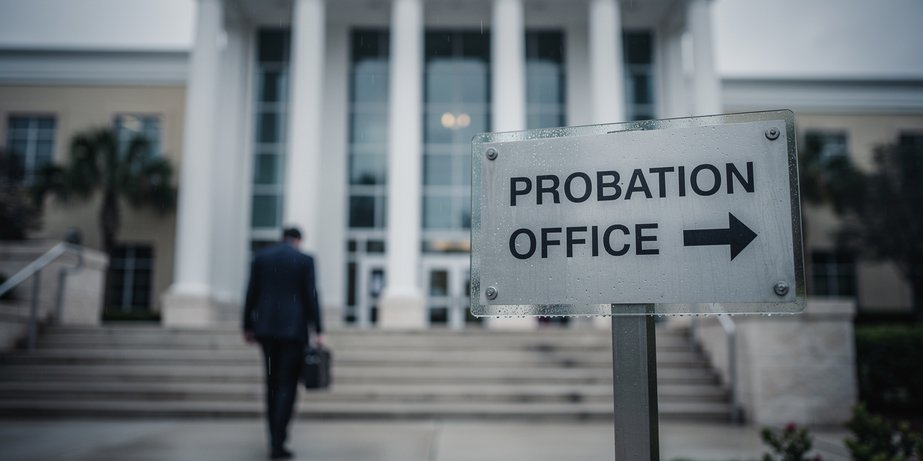
A man on probation misses one appointment because his car broke down, calls his officer the next morning to explain, and assumes that handles it. Two weeks later he is arrested at work on a warrant, held without bond, and facing the entire sentence the judge originally suspended. He has not been charged with a new crime. Here’s why a violation of probation is a fundamentally different proceeding from a criminal case, which protections do not apply, and what actually determines the outcome.
It Is Not a New Prosecution
The reason everything feels wrong in a violation case is that people expect the rules of a criminal trial, and those rules largely do not apply.
Florida Statute 948.06 governs violations of probation and community control. The proceeding is not a prosecution for a new offense. It asks whether a person already convicted has complied with conditions a court imposed, and the sentence at stake is the one that was always hanging over the case.
That framing explains the differences that follow. The state is not proving guilt. It is asking a judge to find that terms were broken.
The Protections That Disappear
Three differences account for most of the shock.
There is no jury. A single judge decides whether a violation occurred, and in the ordinary case it is the same judge who imposed probation in the first place.
The standard of proof is not beyond a reasonable doubt. The court decides whether the violation was willful and substantial, measured by the greater weight of the evidence. That is a materially lower bar, and cases that would not survive a criminal trial can and do result in revocation.
Hearsay is admissible at a violation hearing in a way it would not be at trial. There is a limit, in that a revocation cannot rest solely on hearsay, but a hearing can include evidence a jury would never hear.
Bond Is the Immediate Problem
The first thing families confront is that the usual expectation about bond does not hold.
A person arrested on a violation warrant is frequently held without bond pending the hearing, and there is no entitlement to release of the kind that exists on a new charge. Whether bond is set at all rests with the court.
That has a practical consequence that shapes the whole case. A person sitting in custody faces pressure to resolve the matter quickly, and quick resolutions in violation cases frequently mean accepting the sentence rather than contesting whether a violation occurred.
Willful and Substantial
Those two words are where most violation cases are actually won, and they are worth taking apart.
A violation must be willful. Conduct that was not within the person’s control is not willful, and this is the defense that most often succeeds. A missed appointment caused by a documented medical emergency, a failure to pay by someone who genuinely could not afford it, or a missed curfew caused by a mandatory shift at work are categorically different from indifference.
The inability-to-pay point deserves emphasis. A person cannot be revoked merely for failing to pay money they did not have, and a court considering a monetary violation has to reach the question of ability rather than treat nonpayment as self-proving.
A violation must also be substantial. Minor, technical deviations that do not undermine the purpose of supervision should not support revocation, and arguing that a breach was trivial rather than denying it occurred is frequently the stronger position.
Technical Versus Substantive
Violations divide into two kinds, and they call for different approaches.
Technical violations involve the conditions themselves. Missed reporting, failing a drug test, falling behind on costs, moving without permission, missing a class or a treatment session.
Substantive violations involve a new criminal offense committed while on supervision, and these are harder because the violation case and the new case run together. A person can be found in violation on the lower standard even where the new charge is weak, and sometimes even where the new case is later dismissed, since the two proceedings answer different questions under different burdens.
Where both are pending, sequencing matters enormously and should be handled deliberately rather than letting the calendar decide.
What the Judge Can Do
Revocation is not the only outcome, and the range of available dispositions is where good advocacy pays.
A court can reinstate probation on the same terms, modify it by adding conditions such as treatment or increased reporting, extend the period of supervision, or revoke it and impose a sentence up to the maximum for the original offense.
That last phrase is the one that matters most. The exposure on a violation is the sentence available on the underlying conviction, not some lesser penalty tied to the violation itself. A person who took probation on a third-degree felony to avoid prison is facing that prison term again.
What Actually Helps
Judges in these hearings are deciding whether supervision can still work, and the evidence that answers that question is practical rather than legal.
Proof of employment. Documentation of treatment already begun, voluntarily, before the hearing. Payment of outstanding amounts where possible. Records explaining the circumstances of the alleged violation. Letters from employers, counselors, or family members who can speak to stability.
A person who walks in having already fixed the underlying problem presents a very different case from one who walks in explaining it. The first is asking the court to continue something that is working. The second is asking for another chance.
Two instincts also consistently damage these cases.
The first is explaining the situation to the probation officer at length before anyone has reviewed the file. Those statements are reported and they become evidence, and an explanation offered to smooth things over routinely functions as an admission.
The second is absconding. A person who stops reporting because they are afraid of a violation converts a technical issue into a far more serious one, and they lose the credibility they will need at the hearing.
Treating the Violation as the Real Case
Violation proceedings get treated as an administrative afterthought by almost everyone except the people in them, and that is precisely backwards. The exposure is the full original sentence, the protections are thinner, and the decision rests with one judge.
Building the record on willfulness, on substantiality, and on what the person has already done to fix the problem, rather than showing up to explain, is where our team at Reynoso Erickson Trial Law does the most useful work on a violation.