
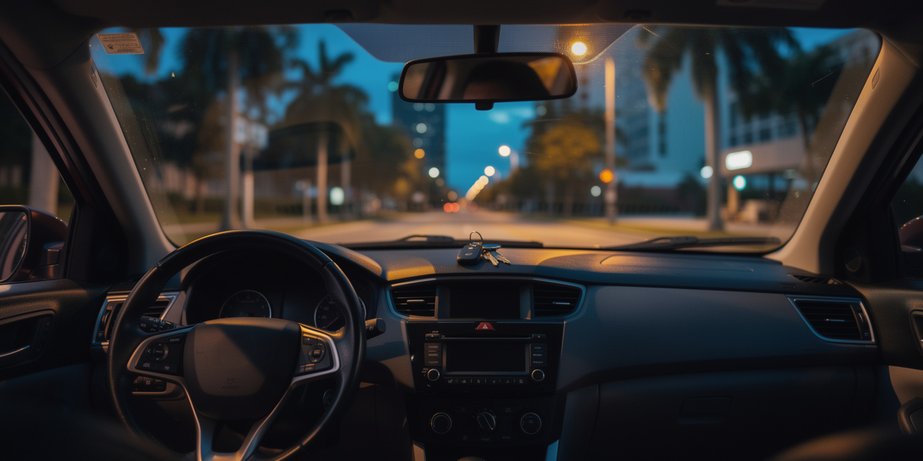
A driver pulls into a parking lot at two in the morning, decides he has had too much to drink, and does what everyone says to do. He stays put. He reclines the seat, runs the engine for the air conditioning, and sleeps. An officer taps the window at four and he is arrested for DUI, having never left the space he parked in. People hear that and assume there must be more to the story. There is not. Here’s what actual physical control means in Florida, why the responsible choice can still produce a charge, and where these cases are actually fought.
The Statute Does Not Require Driving
Florida Statute 316.193 defines the offense in terms of a person who is driving or in actual physical control of a vehicle while under the influence to the extent that normal faculties are impaired, or with a blood or breath alcohol level of 0.08 or above.
Those are two separate ways to commit the same offense. Driving is one. Actual physical control is the other, and it exists precisely because the Legislature did not want the state to have to prove movement.
So the common belief that an officer must have seen you drive is wrong, and it is wrong in a way that surprises people at the worst possible moment.
What Control Means in Practice
Florida courts look at whether a person had the capability to operate the vehicle, considering the circumstances as a whole rather than any single fact.
Where the person was sitting matters. Where the keys were matters. Whether the engine was running matters. Whether the vehicle was operable matters. Where it was parked matters. None of these is decisive by itself, which is why these cases turn so heavily on specific details that nobody thinks to preserve at the time.
The practical effect is that two people who made nearly identical decisions can end up in very different positions depending on facts that felt irrelevant when they made them.
The Problem With the Advice Everyone Gives
Sleep it off in the car is advice people hear constantly, and it is genuinely safer than driving. It is not legally safe, and the distinction is worth understanding before you need it.
Someone who sleeps in the driver’s seat with the engine running for heat or air conditioning has, on most readings of the circumstances, the capability to operate the vehicle. The fact that they were deliberately not driving does not remove that capability, and the statute does not contain an exception for good intentions.
This produces the recurring unfairness in these cases. The person who drove home and was never stopped faces nothing. The person who recognized they should not drive and acted on it gets charged.
Choices That Reduce the Risk
If the situation arises, some decisions are meaningfully better than others. Being somewhere other than the driver’s seat helps. Keys genuinely out of reach help. An engine that is off helps considerably more than one that is running.
None of that is a guarantee, and anyone who can take a ride instead should. But the difference between sleeping in the back with the keys in the trunk and sleeping behind the wheel with the motor on is real.
Where the State Is Weakest
Actual physical control cases have a structural problem the state cannot always solve, and it concerns time.
When no one saw the vehicle move, the state frequently cannot establish when the person last drove, or whether they were impaired at that moment rather than afterward. Someone who arrived sober, parked, and then drank is describing conduct the statute does not reach, and the state’s evidence often cannot exclude it.
That is not a technicality. Impairment at the time of control is what the offense requires, and a case built entirely on a person found asleep in a parked car hours after arriving may have no reliable evidence of when control and impairment overlapped.
Prosecutors know this, which is why the strength of one of these cases usually tracks how much the person said about their own evening rather than anything an officer independently observed.
Dash camera footage, surveillance video from the business whose lot the car was in, and the officer’s own body camera frequently answer the timing question better than any witness can. Those recordings are retained on short cycles and are routinely gone before anyone asks for them.
Why the Charge Is Often Overstated
A report describing a person asleep behind the wheel of a running vehicle reads as an open-and-shut case, and prosecutors file it that way. What the report usually does not address is the question the statute actually asks, which is whether impairment and the capability to operate existed at the same moment.
What Officers Ask and Why
Because the state needs to establish that overlap, the roadside conversation is designed to supply it.
Questions about when you arrived, how long you had been there, where you were coming from, and when you had your last drink are not small talk. Each answer helps place impairment and control in the same window. A person trying to be cooperative and explain themselves routinely supplies the element the state would otherwise struggle to prove.
There is no version of that conversation that improves the situation. The instinct to clear things up is understandable and it is consistently costly.
The same applies to field sobriety exercises and to any explanation offered about how long the car had been sitting there. Each one is an opportunity to supply a fact the state does not otherwise have.
The Second Case Running Alongside
An arrest also starts an administrative proceeding against the driver license that is entirely separate from the criminal case, runs on its own short deadline, and does not wait for anything that happens in court.
People focused on the charge routinely let that window close without realizing it existed. The two cases have different decisionmakers and different standards, and the outcome of one does not control the other.
Anyone whose license matters to their work should treat that deadline as the first priority after an arrest, well before the first court date arrives.
Building the Record Early
These cases are won on details that decay quickly. Who else was present. What the parking lot looked like. Whether the vehicle was even operable. What time the person actually arrived, which a receipt, a rideshare record, or a phone location history can sometimes establish better than memory.
Gathering that while it still exists, and testing whether the state can actually connect impairment to control rather than assuming it can, is where our team at Reynoso Erickson Trial Law starts on a case where nobody was seen driving.