
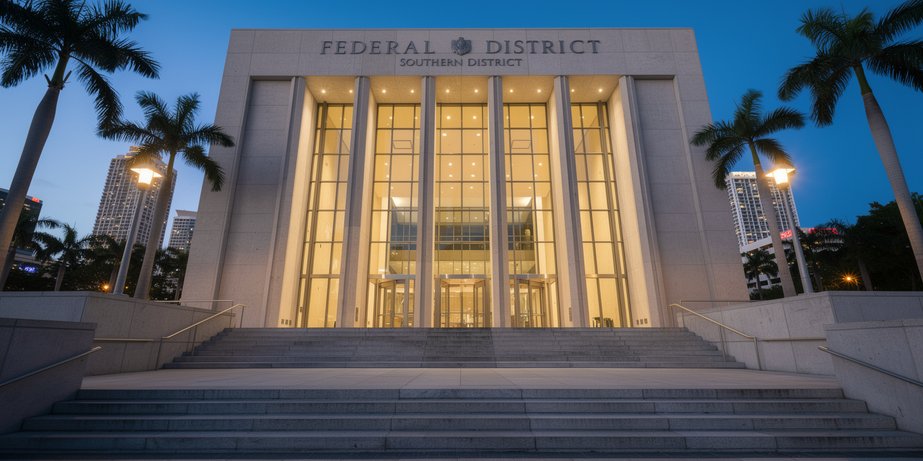
In state court, bond is usually a number. Someone posts it and the defendant goes home. Families arriving at the federal courthouse in Miami expect a version of that, and instead they find a hearing where no amount of money is the question, the government may be arguing that the person should not be released at all, and the decision gets made within days of the arrest. The federal system does not set bail the way Florida does. Here’s what actually happens at a detention hearing in the Southern District of Florida, what the court is weighing, and why the preparation window is measured in hours.
Four Outcomes, Not a Price
The framework comes from the Bail Reform Act, codified at 18 U.S.C. 3142. When a defendant appears, the judicial officer must select one of four outcomes.
Release on personal recognizance or an unsecured appearance bond. Release on conditions. Temporary detention to permit revocation of conditional release, deportation, or exclusion. Or detention pending trial.
Notice that the choice is structural rather than financial. The first question is whether the person is released at all, and the second is what conditions attach. A federal judge is not primarily deciding how much money secures an appearance.
Timing Is the Central Problem
The statute directs that the detention hearing be held immediately upon the person’s first appearance unless a continuance is sought. The government may obtain a continuance of up to three days. The defense may obtain up to five.
Read that against how long it takes to assemble anything meaningful. Character letters, employment verification, a proposed residence, a third-party custodian willing to appear and accept responsibility, financial documentation, treatment records — all of it has to exist within days of an arrest that nobody planned for.
This is why families who start gathering materials the morning after the arrest are in a materially different position than those who wait for a lawyer to tell them what to collect. The continuance exists precisely because that preparation takes time, and using it well is the difference between a proposal and an argument.
What the Court Weighs
Section 3142(g) directs the court to consider several categories of information in deciding whether conditions can reasonably assure appearance and community safety.
The nature and circumstances of the offense charged. The weight of the evidence against the person. The history and characteristics of the person, which reaches employment, family ties, length of residence in the community, past conduct, criminal history, and record of appearing at proceedings. And the nature and seriousness of the danger to any person or the community that release would pose.
The third category is where the defense does most of its work, because it is the only one that describes the person rather than the accusation. Decades in the same community, a stable job, children in local schools, an unblemished record of showing up — those facts are the raw material of a release argument.
The Presumption Cases
In defined categories of cases a rebuttable presumption arises that no condition or combination of conditions will reasonably assure appearance and safety. The statute sets out when that presumption applies, including situations involving certain prior convictions where the new offense was committed while on release and a defined period has not elapsed.
What the presumption does is shift the burden of production to the defendant. It does not shift the burden of persuasion, which stays with the government throughout. That distinction matters enormously in practice and is frequently misunderstood by people watching the hearing.
The practical effect is that in a presumption case the defense has to put something forward rather than simply testing the government’s showing. Silence loses.
What the Hearing Actually Looks Like
The statute guarantees specific rights at the hearing. The person has the right to be represented by counsel, an opportunity to testify, to present witnesses, and to cross-examine witnesses who appear.
In practice the government frequently proceeds by proffer, meaning a prosecutor summarizes what the evidence would show rather than calling agents to testify. The defense can do the same, and can also call witnesses, which is where a proposed third-party custodian typically appears and is questioned about what they are agreeing to.
Whether the defendant testifies is a serious decision made with counsel, because anything said becomes part of the record in a case that is only beginning.
Conditions Are Where Most Cases Are Won
The realistic goal in many of these hearings is not unconditional release. It is a package of conditions substantial enough that a judge can say yes.
Location monitoring. Home detention or a curfew. Surrender of passports. Travel restricted to the district. Third-party custodianship by someone the court finds credible. Property pledged by family members. Restrictions on contact, on financial activity, on internet or firearm access depending on the charge.
A defense that arrives with a specific, verified, and detailed proposal gives the court something to work with. A defense that argues only that detention is unwarranted leaves the judge nowhere to go.
What the Statute Preserves
One provision deserves stating plainly because clients ask about it constantly. The statute specifies that nothing in it shall be construed as modifying or limiting the presumption of innocence.
A detention order is not a finding of guilt and it does not predict the outcome of the case. It is a pretrial determination about appearance and safety, made early, on incomplete information, under a statute designed to be applied quickly.
Why the First Forty-Eight Hours Decide So Much
Detention shapes everything that follows. A detained client is harder to meet with, harder to prepare, and less able to assist with a defense that may involve records only they can locate. Employment usually ends. Family circumstances deteriorate. The practical pressure to resolve a case rises the longer someone sits.
Which is why the hours immediately after a federal arrest carry weight out of proportion to their number, and why federal criminal defense work frequently begins with assembling a release package rather than with the merits. That early stretch, including cases that began quietly as white-collar investigations, is where our team at Reynoso Erickson Trial Law concentrates first.